For the past 30 years, IT sustainability has focused on the physical hardware we use in our daily lives – laptops, screens, smartphones. This remains as important as ever, but today, almost everything we use that hardware for also relies heavily on cloud resources. And while the climate impact of cloud computing has already reached alarming levels, the tools to evaluate it and drive improvements have been lacking – until now, with TCO Certified Cloud.
But how do you even certify something as vague as “the cloud”? In this first article of our Cloud series, let’s take a closer look at the cloud itself – and what it’s hiding.
Demystifying the cloud
The word “cloud” is misleading – and that’s probably very intentional. It sounds soft, weightless, invisible. But behind every cloud service are real machines, inside real buildings, consuming real energy and resources.
The cloud term is also used in a fuzzy way, to describe anything from a finished app to data storage or raw computing power. And without a clear definition of what cloud technology comprises, it’s impossible to write meaningful requirements related to its climate impact.
So what is “the cloud”? To make it easier to grasp, it is commonly described as being made up of three distinct layers, where the main differences lie in how much a company either manages on its own or outsources to someone else:
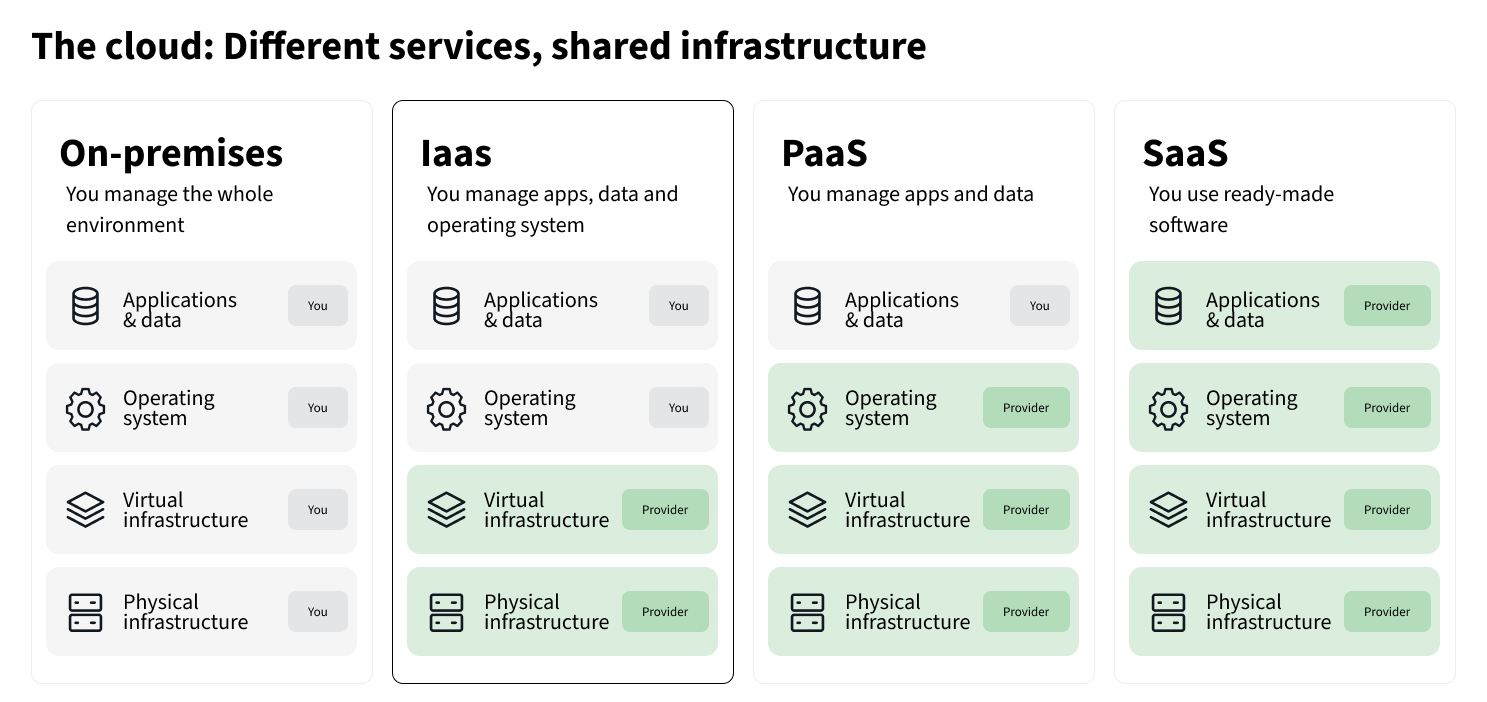
The brands most people are familiar with, and use daily, sit at the top layer. What’s actually running everything is further down in the IaaS layer, almost entirely out of view. This is where the physical servers, storage, and network equipment are – and where the real climate impact occurs. And that’s why the IaaS layer is the focus of TCO Certified Cloud.
A complex footprint
The IaaS layer’s footprint is made up of the energy needed to run and cool the servers, the water that some facilities use for cooling, and the hardware itself, which sooner or later becomes e-waste. None of this is visible from the SaaS/PaaS layers, with which most users interact, but which ultimately rely on IaaS.
We can actually compare using a cloud service to taking a taxi: You don’t own the car, engine or fuel tank, but you’re still responsible for the environmental impact of your ride. The same goes for the cloud – not owning or seeing the servers doesn’t make their impact any less yours.
Redundancy increases the IaaS footprint further. To guarantee capacity, there always have to be more servers than current demand requires, and services are often run in at least two data centers simultaneously, so that operations continue if one fails.
Ultimately, with every cloud service relying on IaaS or similar infrastructure, this means an extremely complex footprint spread across hardware, buildings, and energy supply. Verifying these piece by piece is almost impossible for an individual purchaser. And now, with TCO Certified Cloud, they don’t need to.
Certifying IaaS resources – and beyond
Instead of certifying just the data center or the hardware, TCO Certified Cloud certifies the cloud resource on the IaaS level. This means that the company buying the resource knows that everything underneath follows strict sustainability criteria: hardware, data center, and operations.
As in TCO Certified for IT products, these criteria are organized around four areas: climate, substances, circularity, and supply chain, with clear, concrete requirements. Also, each certified resource is clearly identified by its offering name, its provider, and the data center facility it is delivered from – making it easy for purchasers to specify the resources their IT departments can choose from.
Once IaaS resources can be certified, it also becomes more realistic to set standards for the companies buying them, whether it’s for their own operations or to build and sell PaaS and SaaS. In that way, improvements can gradually work their way up to the PaaS and SaaS layers.
Making the cloud footprint visible – and understandable
So while the cloud may feel abstract, it is a very physical infrastructure with a real, measurable footprint. TCO Certified Cloud makes that footprint visible and verifiable at its most relevant level while helping purchasers understand what their own use of cloud resources amounts to.
How does it do that? In our next article, we’ll be showing how we turn cloud climate impact into concrete, usable data.
